

Executive Summary
This report updates our 2023 analysis of Gavi’s marginal cost-effectiveness, in light of the expected ~$2B funding shortfall arising from the 2025 replenishment (Gavi 6.0, 2026–2030). As of August 2026, the United States (US) has unfrozen significant funding, narrowing the current gap to ~$1.1B. Furthermore, additional US commitments may later become available, which could potentially close the gap entirely over the full strategic period. Given the shortfall and uncertainty around its persistence, our central question is: If a philanthropic funder gave Gavi a marginal dollar today, how cost-effective would it be?
How Gavi has responded to the shortfall
Rather than cutting entire programs, Gavi pursued cost reductions through a formal process of recalibrating ambitions to fit the smaller anticipated budget of $10B. Cost savings came through reduced coverage caps, scoped-down campaigns, Secretariat cuts, renegotiated vaccine prices, stricter country co-financing, and non-grant financing. Gavi also shifted the vast majority of vaccine funding into capped Country Vaccine Budgets (CVBs), moving more allocation decisions to the country level in a roughly 80/20 split between guaranteed budgets (most prioritized programs) and discretionary budgets (a menu from which countries can select additional vaccines). Gavi estimated these measures will cost 580,000–780,000 additional lives, versus its original ambitions.
Where marginal funding would go
We modeled three avenues via which additional funding could plausibly flow, using Social Return on Investment (SROI) as our cost-effectiveness metric against Coefficient Giving (CG)’s 1,000X bar,[1] with the assumption that marginal returns diminish as the shortfall shrinks:
- Reversing cost-cutting measures: We estimate these separately as the average of cuts across vaccine procurement (~1,200X), the Fragile & Humanitarian Approach (~4,700X),[2] and Health System & Immunization Strengthening (~2,100X).[3]
- Expanding CVBs: Closing remaining gaps in guaranteed budgets (~6,300X) is highly cost-effective, though likely to be filled by other funds, while discretionary budget top-ups average ~850X and will vary widely by country.
- New vaccines entering the pipeline: We think this is less likely to be at the margin, and new programs have variable cost-effectiveness. At the upper end, SROIs are estimated to cross >3,000X for an adolescent/adult tuberculosis (TB) vaccine and the maternal respiratory syncytial virus (RSV).
Our headline findings
Before sharing our results, a few caveats are useful to keep in mind:
- What constitutes “the margin” for Gavi is constantly in flux, so our results here may quickly become outdated. Our central approach examines marginal cost-effectiveness based on the existing budget shortfall (as of early August 2026). While drafting the report, the US recommitted funds to Gavi, reducing the previous gap by one-third and potentially closing it entirely over the course of Gavi 6.0. We do not examine what marginal cost-effectiveness looks like beyond Gavi’s original ambitions for this time period, as that was out of scope for our planned analysis.
- Our cost-effectiveness estimates are heavily reliant on figures of cost and health impact produced by Gavi. We were not able to assess all of the underlying assumptions that went into these estimates, so we adjust these figures to some extent based on our own interpretation of their reliability but with limited confidence.
Our main findings:
- Gavi’s budgetary shortfall, as of August 2026, stands at roughly $1.1B, due to the US releasing $600M in contributions for 2025–2026. We think this means there is a >50% chance that the US will continue to unfreeze the rest of its prior commitments in the future, which would effectively wipe out the funding gap for Gavi 6.0.
- We expect, with medium confidence, that Gavi is likely to prioritize additional funds–beyond the down-scoped $10B expenditure targeted in the recalibration–by first filling gaps and meeting country demand for vaccines, reversing at least some of the deeper cuts to specific programs, restoring funding for supporting countries in fragile settings, and setting up outbreak response.
- We estimate, with medium confidence, that the SROI of additional funding to Gavi, given the current ~$1.1B shortfall, is in the region of 850–2,100X, though this would be expected to change if the shortfall ultimately vanishes.
Bottom line: We think recent US funding will fill up most of the highly cost-effective opportunities, leaving the marginal cost-effectiveness of closing Gavi’s remaining ~$1.1B shortfall at 850–2,100X—most of which sits roughly at the CG bar. However, Gavi does not allocate funds solely based on cost-effectiveness, potentially leaving attractive opportunities on the table. If further anticipated US appropriations materialize, this would push the true margin for philanthropic donors beyond Gavi 6.0’s original ambitions and likely below the CG bar.
Introduction
This report, commissioned by Coefficient Giving (CG), examines the marginal cost-effectiveness of Gavi, the Vaccine Alliance. We previously conducted research on this question in 2023; our report (van Schoubroek et al., 2026) at that time predicted a $0.7B funding shortfall for Gavi’s 2025 replenishment (Gavi 6.0, 2026–2030) and estimated the cost-effectiveness of marginal vaccines for the 2025 replenishment. Using Social Return on Investment (SROI) as the measure of cost-effectiveness, we found that average SROI was ~200–1,400x across the categories of vaccines we thought Gavi was most likely to view as marginal at the time.
Since our previous report, Gavi’s 2025 replenishment has occurred, in which donors pledged just over $9B against Gavi’s $11.9B target for the 2026–2030 period, leaving a shortfall of roughly $3B following the summit. This was largely driven by the US’ withdrawal of all future funding and a ~25% lower commitment from the UK, Gavi’s historically largest donor, resulting in a shortfall considerably larger than expected and the first seen in a Gavi replenishment. By the end of 2025, Gavi expected a total resource pool of $10B, leaving behind an anticipated final $2B gap. Meanwhile, Gavi’s strategic reforms (the “Gavi Leap”) moved away from rolling applications (where countries who applied first had priority) toward equal, advance visibility into a five-year budget envelope for every country.
In response to the expected funding gap, Gavi has responded differently than we had assumed in 2023: instead of cutting or delaying entire vaccine programs, Gavi stated that it aims to maintain its core targets as much as possible and reduce costs in other ways.[4] Gavi’s Board has recalibrated the organization’s ambitions to match an anticipated $10B target through a mix of cost-cutting and financing measures, rather than a proportional scale-back of its programs. This included a ~30% reduction in Secretariat operating costs, renegotiated vaccine prices, more stringent co-financing requirements for countries, and complementary financing mobilized from development banks as loans and liquidity facilities, rather than grant funding. Notably, during the writing of this report, the US also unfroze $600M in commitments for 2025 and 2026, considerably reducing the current budget shortfall and potentially leaving no shortfall at all for Gavi 6.0, if other previously-committed funds for later years also materialize.
In this analysis, updated for the 2026 funding landscape, our central question remains: If a philanthropic funder gave money to Gavi today, how cost-effective would that marginal dollar be? To answer this question, we investigate three potential avenues for cost-effectiveness:
- Efficiency gains from reversing Gavi’s existing cost-cutting measures. Since the funding shortfall has been absorbed substantially through changes to routine vaccine procurement, as well as other programs to improve health systems and support for the poorest countries, we approximate the cost-effectiveness of a marginal dollar that reverses these measures.
- Cost-effectiveness of vaccines available within CVBs. Since nearly 90% of Gavi’s vaccine procurement budget is now allocated directly to countries as lump-sum envelopes—with guaranteed programs funded first and remaining discretionary budget available for country-prioritized vaccines—a marginal donor dollar may functionally flow through country-level discretionary choices rather than a single global program.
- Vaccines newly entering Gavi’s active pipeline. Most of these vaccines are currently in the in-principle or learning-agenda stage, rather than full programmatic rollout (Gavi, 2024). A significant infusion of philanthropic funding could plausibly accelerate their timelines by, for example, shortening the runway between in-principle approval and full Board approval, expanding the initial set of countries able to introduce these vaccines, or letting Gavi move past the learning-agenda stage sooner than it otherwise would under current budget constraints.
We answer these questions through a combination of desk research, cost-effectiveness modeling, and four expert interviews, from the perspective of a larger, persistent shortfall.
Gavi’s 2026 Funding Landscape
Current 2026–2030 Funding Landscape Leaves a ~$1.1B Gap
At the June 2025 pledging summit in Brussels, world leaders pledged over $9B towards Gavi 6.0, leaving behind a ~$3B gap between targeted and pledged funding. The most notable change in funding was the complete withdrawal of the US, due to unfounded vaccine safety claims.[5] Following the summit, forecasted resources were set to reach $10B; for the first time in its history, Gavi recalibrated planned expenditures to match this reduced forecast, of which $5.9B was allocated to vaccines ($5.3B for CVBs; $600M for outbreaks and other costs), $3.4B to cash programs (including campaign cash support and partner costs), and $700M to the secretariat (Gavi, 2025).
Several subsequent changes to the budget also further reduced the funding shortfall. As of Gavi’s July 1–2, 2026 board meeting, the organization reported having reached approximately $10.2B in secured funding, narrowing the shortfall to ~$1.7B (Gavi, 2026, p. 4). More substantially, on July 30, 2026, the US unfroze $600M in congressionally approved funding for Gavi for fiscal years (FY) 2025 and 2026 (Gavi, 2026). This brings current total funding for 2026–2030 to ~$10.8B, leaving a much reduced shortfall of $1.1B (shown in Figure 1 below).[6]
Figure 1: Progress towards the Gavi 6.0 replenishment target, July 2025–August 2026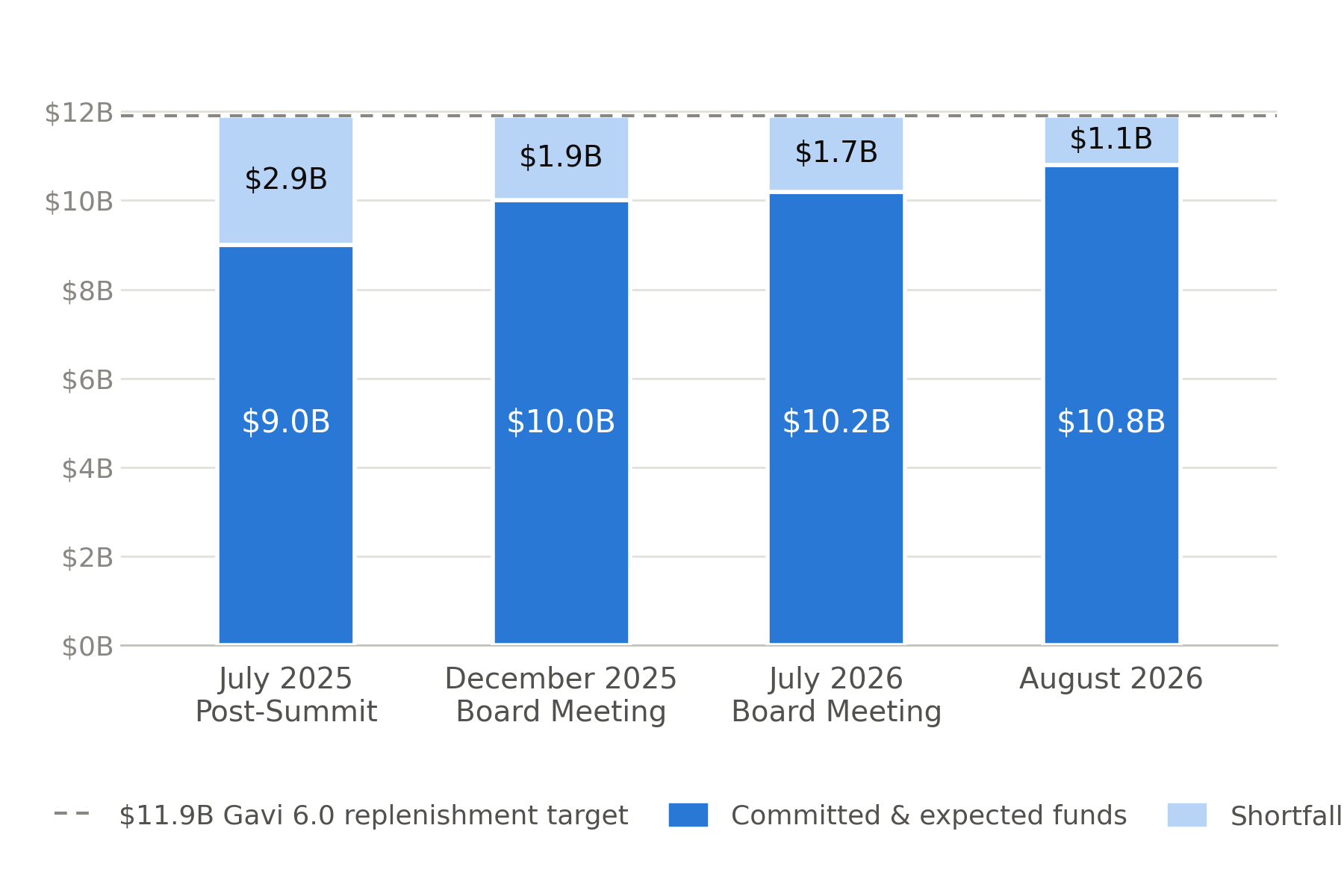
Though the US only released $600M of the congressionally appropriated funds, it now appears >50% likely to us that the remainder of the $300M/year funds for Gavi for subsequent years will materialize, which would leave Gavi essentially fully funded for Gavi 6.0. Pete Baker (CGD) strongly supported this in an interview, saying: “I think you would bet that almost all of the 1.5B now would come in from the US, [given] the [upcoming] midterms and … [that] Congress is moving towards being more supportive, not less. Why would anything less than 300M a year be released? And 300M a year is exactly 1.5[B], which takes you up to the full [amount pledged].” While there is still risk attached, given that funds would need to be reapproved by the US annually, it now seems more likely than not to us that some amount of additional funds will come through eventually.
If the US contributions eliminate the funding shortfall completely, this changes the margin for philanthropic donors substantially: instead of the margin falling within the original targets of Gavi 6.0, it would instead move beyond the original ambitions. In our analysis, we consider the current shortfall of ~$1.1B in committed funds, with the acknowledgement that Gavi’s funding landscape–and therefore its marginal cost-effectiveness–is a moving target.
How Gavi Responded to the Funding Shortfall
Facing the funding shortfall following the June 2025 pledging summit, Gavi entered a six-month strategic “recalibration” phase, ultimately agreeing to a ~$3B cost reduction (roughly a quarter of the planned Gavi 6.0 expenditure). The expected cost reductions exceed the current shortfall because further funds have been released or secured since the recalibration occurred. Rather than an across-the-board cut to programs, Gavi used several distinct levers to reduce planned spending (Gavi, 2025). With these reforms, Gavi aimed to trim vaccine programs as modestly as possible (by ~$1.8B, of which roughly ~$1B comes from scoping and pacing of new vaccine introductions and the remainder from country-led reductions, out of the total $3B cost reduction).[7] Alongside these cuts, Gavi accepted the risk of up to ~780,000 future lives lost, as well as reduced health systems support for maintaining routine coverage, insufficient stockpiles for outbreaks, and unmet country demands. Specific cuts include:
- Recalibrating existing vaccine programs. Gavi also cut ~$200M from global stockpile funding and halved a separate ~$200M vaccine-procurement contingency budget. The Board also gave explicit targets for reduced scope or pacing for five programs:[8]
- Malaria: The coverage cap in moderate and high-transmission areas was cut from 85% to 70%, though narrowed to apply only to countries introducing or scaling up the vaccine, yielding ~$175M in savings. Gavi’s CEO, Sania Nishtar, stated in an April 2026 interview that “our malaria programme has taken the heaviest cuts [to all programs]” (France24, 2026).
- M/MR: Catch-up and follow-up campaigns were scoped down for a revised ~$90M reduction.
- Cholera: Pacing new preventive campaigns was estimated to save ~$265M.
- Hexavalent: Changing from a four-dose to three-dose schedule was estimated to save ~$60M.
- IPV: ~$10M in cost savings are predicted from reducing scope by transitioning to fractional dosing in six “polio low risk” countries in 2027.[9]
- Shifted responsibility to countries directly via CVBs. In a major strategic shift, nearly 90% of the budget available to Gavi for vaccine procurement in its next strategic period will be allocated directly to countries, pushing marginal vaccine decisions to country-level ownership (Gavi, 2025).
- Cutting cash grants to countries for health systems. Countries will see an overall ~22% decline in cash funding, including a much steeper ~40% reduction in health systems strengthening (HSS)-like support specifically. This is partially offset by consolidating previously separate funding levers into a single, more flexible cash grant with a floor of $5M and cap of $120M per country.
- Cutting Secretariat and partner operating costs. In practice, this meant reducing costs (e.g., by shrinking the headcount of Geneva- and US-based staff) by 33% (Gavi, 2025). This would save ~$150M in costs over the five-year period, relative to Gavi 5.0 (ibid., p. 11). In addition, WHO and UNICEF will see a ~25% reduction in funding for their vaccine-support roles starting in 2026, shifting more direct decision-making and delivery responsibility to countries themselves (ibid., p. 13).
- Relying on manufacturer price reductions for some vaccines. For example, a November 2025 agreement secured a lower price per dose for R21, one of Gavi’s two malaria vaccines, at ~$3/dose by roughly the end of 2026 (Gavi, 2025). This is expected to result in ~$90M in savings for Gavi and countries. The Board’s Market Shaping Strategy targets $800–950M in vaccine procurement savings overall via reduced weighted-average prices across the whole portfolio, though the feasibility of hitting this target in full remains unclear.
- Using supplementary financing beyond donor pledges. More than $4.5B in new financial instruments and partnerships, including $3B from multilateral development banks, have been leveraged to provide countries with flexible, long-term support as they transition from aid to self-sustained financing (Gavi, 2025).
In the July 2026 Gavi board meeting, the Board noted that additional financial resources of $222M “will be allocated to countries following the revised approach,” therefore “likely cover[ing] most of the additional 2026 and 2027 needs” (Gavi, 2026, p. 11). However, this still leaves behind a ~$150M gap in guaranteed funding for programs for 2029–2030 (Gavi, 2026, p. 14–15), driven by vaccine price and volume changes since the recalibrated December 2025 budget.
Estimated Lives Lost by the Funding Shortfall are ~580,000–780,000
Though Gavi aims to minimize health impact as much as possible, the funding shortfall undoubtedly translates into lives lost. During the recalibration, figures of health impact attached to specific cuts were forecast, with further adjustments to planned changes in scope approved in the December 2025 board meeting. Recalibrated targets estimate ~580,000–780,000 additional deaths (Gavi, 2025, p. 22). These are projected to come from planned reductions in routine programs or campaigns (~300,000–400,000 lives lost from both direct program reductions and from the new country vaccine envelopes) as well as changes to Health Systems & Immunization Strengthening (HSIS) and Fragile & Humanitarian (F&H) budgets (280,000–380,000 lives lost). These figures are summarized in Figure 2 below, with a further breakdown of each category available in this spreadsheet:
Figure 2: Gavi 6.0 (2026–2030) recalibrated cost reductions and associated health impacts
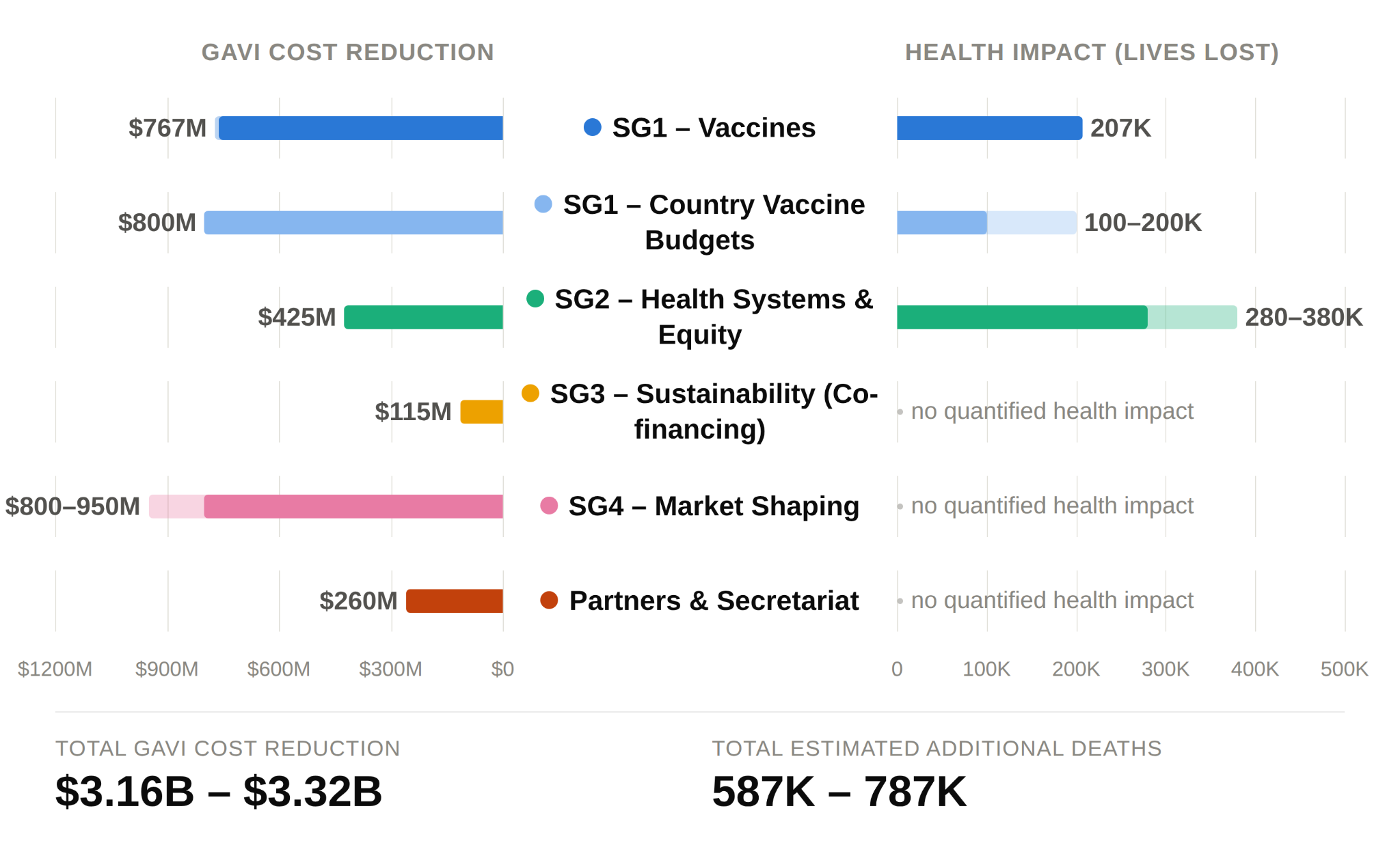
Note. SG = Strategic Goal. Where a range is given (low–high), the solid bar segment shows the low end and the lighter segment extends to the high end. Part of SG3 cuts (introducing campaign co-financing costs for countries) carries an unquantified indirect risk via campaign delays that is not reflected in the health impact figures.
Without being able to assess the specific modeling assumptions behind these forecasts, we have medium confidence in their accuracy, and the magnitude of lives lost depends in part on the exact ways in which countries themselves respond to restricted funding.
New Country Vaccine Budgets Put a Hard Cap on Programs
Since Gavi’s founding, countries could apply for as many vaccine programs as they had capacity and co-financing for, such that the resource constraint was demand-driven. In Gavi 6.0, however, each country instead gets a set, capped CVB it must work within, made up of two broad components (shown in Table 1 below):
- Guaranteed programs: Funding reserved for a fixed list of nine priority vaccines, with country allocations calculated directly based on Gavi’s internal forecast. If a country chooses to self-finance one of these vaccines, it can keep the money to spend elsewhere within its envelope; if it declines a vaccine entirely, the funds go to other countries.
- Discretionary programs: The remainder of the country’s budget, calculated via a formula, is funding that the country can direct toward any other eligible Gavi vaccine or campaigns of their choosing.
Table 1: Guaranteed and discretionary Gavi vaccine programs in Gavi 6.0
| Guaranteed vaccine programs | Discretionary vaccine programs |
|---|---|
|
|
CVBs are also expected to work in practice using the following principles (Gavi, 2025):
- The vast majority of vaccine funding is reserved for guaranteed programs. ~80% of the $5.3B allocated to CVBs is committed to the guaranteed programs, leaving $1.1B to discretionary programs. Gavi also forecasts that unmet country demand is ~$500M, meaning that some vaccine programs and campaigns that countries would otherwise pursue are unable to be funded even before in-country prioritization occurs.
- Budgets are largely determined by a simple formula, prioritizing the poorest countries with highest child mortality. We were unable to find the exact formula used by Gavi internally, but the two named components are inverse gross national income (GNI) per capita and the under-5 mortality rate. Specific CVBs, and the amounts divided between guaranteed and discretionary budgets, can be seen in Appendix A.
- Floors and caps ensure inter-country equity and continuity. The floor guarantees Initial Self-Financing (ISF) countries (i.e., the countries in the lowest income tier) enough money to maintain their existing discretionary programs, while the cap limits any country’s maximum allocation to the cost of introducing every vaccine it would be eligible for.[10]
- CVBs will be regularly reviewed and funds reallocated. Gavi will periodically review each country’s performance and spending against its CVB and can reallocate funds, both to promote efficient use and to redistribute money if the overall resource envelope changes.
- Malaria becomes a discretionary vaccine with stricter co-financing rules, but ~$700M in funding is guaranteed. Countries will now pay the standard co-financing rate, rather than the discounted rate malaria previously received, and Gavi will only fund coverage up to 70% of a country’s eligible population. This is down from as high as 85% coverage for some countries, creating a combined $145M funding gap across the countries needing to self-finance up to or beyond the 70% threshold. Despite these tighter rules, the floor for ISF countries assures $684M for malaria specifically, protecting the bulk of the program even as Gavi’s overall support reduces. This may mean that countries will choose to fill up at least part of their discretionary budgets with malaria programs.[11]
Key takeaways for our modeled estimates of cost-effectiveness:
- A substantial gap in demand exists between vaccines countries want and those that funding can support, beyond guaranteed programs.
- Countries have some agency in the vaccines they choose, but discretionary budgets are small relative to guaranteed budgets.
- Regular review and reallocation of CVBs also means that marginal cost-effectiveness estimates on the country level may change over time and vary substantially country-to-country.
Would Additional Funding to Gavi be Cost-Effective at the Margin?
Our analysis below is conditional on the persistence of a shortfall throughout the Gavi period, which we now think is moderately (<50%) unlikely as a result of the US freeing up funds. If the shortfall is eventually filled by the US (or other non-philanthropic contributors), we expect that the marginal cost-effectiveness would be lower than our estimate below.
How We Think Gavi Would Respond to More Funding
Any budgetary changes as a result of additional funding for Gavi 6.0, including the recent $600M commitment from the US, require a formal process of Board approval. This means that even though the shortfall has been substantially reduced recently, the specific order of changes is still unknown. Donors can also earmark funds for specific programs, which may mean that some allocations either could be given to less cost-effective programs based on donor preference, or steered towards the most cost-effective programs by impact-maximizing donors.
Furthermore, some responses to additional funds might be driven by practicalities.[12] In an interview, an anonymous expert at Gavi emphasized the difficulty of going back on cuts that Gavi has already made in light of new funding: “It’s a really complex process just because of how complicated our vaccine programs are and how forecasting works. It’s really difficult to [do] what we call ‘reverse recalibrate,’ because making the recalibration decision already was [so] complex.” If additional US funds materialize, we think this would likely make such piecemeal reversals obsolete, and Gavi would largely return to its original ambitions.
Gavi also noted in its July 2026 board meeting that philanthropic donors have signaled interest in providing substantial support for filling the gap in guaranteed CVBs as a priority, with additional interest in reversing the malaria cuts and potentially those for other vaccines (Gavi, 2026, p. 9). The Board also explicitly noted that “additional donor resources available to Gavi (if any) will be allocated to fill the remaining funding gap in guaranteed budgets and the Initial Self-Financing floor.” As the gap in guaranteed budgets and the ISF floor is only expected from 2028 onward, Gavi noted that if the hole has not been filled by that point, the Secretariat would then “conduct a holistic review of all Gavi funding envelopes to fill that gap” (Gavi, 2026, p. 11), likely meaning that other funding would be reassessed in order to make up the shortfall.
Based on expert interviews and our reading of Gavi’s Board materials (particularly Gavi, 2026, p. 7), we think Gavi would respond to unrestricted funding based on the following principles:
- Ensure vaccine procurement is the top priority.[13]
- Preserve continuity of existing programs, even if a more cost-effective new program is available.[14]
- Support expansion of existing programs within guaranteed budgets (or discretionary budgets to meet the floor for the poorest [ISF] countries).
- Prioritize offering countries decision-making power within CVBs while maintaining essential support for the poorest countries. This would generally follow the hierarchy of guaranteed budgets and then discretionary budgets for existing programs, followed by new introductions and campaigns for ISF countries before those in the process of reducing their reliance on Gavi (i.e., Preparatory Transition (PT) or Accelerated Transition (AT) countries).
In our interview with an anonymous expert at Gavi, he specifically flagged the following categories as high priorities for Gavi:
- Vaccine budgets (guaranteed and discretionary)
- Cuts to the F&H Approach [15]
- Outbreak response (particularly vaccine stockpiles)[16]
He also stated that postponing VIS candidates was not currently under discussion, but that the size of the budget was minimal compared to other cuts, so he did not believe those programs would be affected by additional funding.[17]
Plausible Models of Marginal Cost-Effectiveness
We assessed a number of likely categories for marginal cost-effectiveness using back-of-the-envelope calculations (BOTECs). Our choice of BOTECs takes into account areas we think more money would likely be directed to first and the feasibility of constructing a BOTEC using Gavi forecasts. For simplicity, we chose to focus only on SROI estimates for cuts that included both a specific estimate of (i) Gavi costs,[18] and (ii) health impact, in terms of expected deaths averted.[19] We considered other budget reductions in reaction to the funding shortfall–like increasing country co-financing costs or streamlining the Secretariat–out of scope for our analysis because of the complexity of linking the cuts to specific health impacts.
We see three broad categories of how marginal cost-effectiveness might function for Gavi 6.0, given a continued funding gap:
- Cost-cutting measures that Gavi took in response to the shortfall will be reversed. We think it is moderately likely that Gavi would use additional funding at least in part to restore some of these cuts (e.g., higher malaria coverage support), while others seem less likely to be prioritized (e.g., fully re-hiring Secretariat staff). We focused on three types of cuts:
- CVBs will be topped up or increased. We think with medium-high confidence that it is likely that substantial additional funding would translate into increased CVBs.[21] However, we are highly unsure how additional funds would be allocated; it seems plausible but unlikely that all CVBs would be increased proportionally (up to the cap) and more likely that countries with greater unmet need or a stronger track record of using funds efficiently would receive disproportionately more money.
- Vaccines that are entering the pipeline will have accelerated timelines for deployment. Approval decisions for newly-approved and previously-approved vaccines that are pre-rollout are, in some cases, explicitly dependent on available funding.[22] We believe it is more likely that these programs would be delayed as a result of more constrained funding, as rollout is not planned until later in the Gavi 6.0 timeline (see Appendix B for more details), though Gavi has not indicated that any changes to these programs are planned as part of the recalibration.
Our Estimate of Marginal Cost-Effectiveness in 2026 is ~850–2,100X
Our headline results show that Gavi is a very cost-effective bet in the case of a substantial (>$1B) shortfall, with some gaps valued at up to an SROI of ~6,300X. Given the incoming $600M from the US and other recent financial revisions, we think the marginal cost-effectiveness of programs making up the current remaining ~$1.1B in funding shortfalls is in the range of ~850–2,100X–the majority of which falls right around CG’s cost-effectiveness bar. However, in the likelihood of anticipated future funds arriving from the US, the margin for philanthropic donors may now fall even beyond Gavi’s original ambitions of $11.9B. We did not assess explicitly marginal cost-effectiveness beyond $11.9B due to time constraints, but we expect that additional funds would be spent at an SROI at or below our lower-bound estimate of 850X.
Methodology
In our BOTECs, we calculated the SROI in CG terms as the health impact generated (in CG-valued DALYs) divided by Gavi expenditure (in US$). CG has historically evaluated programs or investments relative to a 2,000X bar, but it reduced this to 1,000X in July 2026 (Berger & Reid, 2026); we use the new, lower bar as the marker of cost-effectiveness in our analyses below. All underlying calculations and sources are available in our cost-effectiveness model.
We used Gavi’s own public estimates of its expenditure or cost-savings alongside projected health impact to assess the value-for-money of different programs or the reversal of programmatic cuts for the 2026–2030 time period , with adjustments.[23] The underlying estimates of health impact are built by an independent technical group of modelers (the Vaccine Impact Modelling Consortium); the methodology of which has been extensively published in peer-reviewed research, giving credibility to the forecasts. Nevertheless, the estimates are drawn from modeled counterfactuals (not directly observed outcomes) that embed assumptions about coverage, vaccine efficacy, and disease burden that could potentially overstate Gavi-attributable impact.
Given this, we adjust Gavi’s health impact estimates based on our own low-confidence estimates of the reliability of their figures. For instance, we applied minor haircuts to Gavi’s health impact estimates to account for uncertainty around whether or not gaps in the budget would be filled from other sources and underlying uncertainty about whether these numbers would tend to be over- or under-estimated.[24] Furthermore, budgets can continue to fluctuate based on factors like exchange or interest rates, so the precise scale of funding allocated to each program should be taken as directional rather than precise. Within each category, we calculated cost-weighted average SROIs across vaccines or specific cuts based on the proportional cost of each program. Vaccines appearing in more than one category of analysis are estimated on different bases (i.e., cut-reversal estimates are marginal, while CVB estimates are program averages), so SROI values may not be directly comparable across categories.
We also applied the following assumptions across all categories:
- Morbidity: For health impacts, we used DALY estimates when available to account for the preventive effects of vaccination on both morbidity and mortality. Where only deaths were available, we converted these figures into DALYs based on the value of preventing mortality, but do not include any value of preventing morbidity. However, for most of the vaccines in Gavi’s current portfolio, morbidity accounts for <5% of the DALY burden, so we do not expect our results would change meaningfully if it were to be included.[25]
- Discount: We also applied a discount to Gavi’s estimates of positive health impact of 20%, meaning that we expect that Gavi’s programs are slightly less effective than they predict.[26] For estimates of loss of lives saved, we reduce the haircut to 10% instead; unlike forecasts of future health impact, we were unsure if these forecasts were more likely to be under- or over-estimates, but on balance, we think that estimates at the margin are likely to be slightly more accurate than programs as a whole.[27]
- DALYs per life saved: Where possible, we used direct DALY figures from Gavi’s forecasts. In cases where only future deaths are predicted, we converted those deaths into age-weighted CG DALYs, using 51 DALYs for each life saved under 5 and 32 DALYs for those over 5. Each DALY is then valued at CG$100,000.
- Under-5 share: We estimated the rough proportion of deaths occurring in children under 5 for each vaccine where possible. Where vaccine-specific estimates were not available, we used a value of 62% of deaths occurring among those under 5.[28]
- Government counterfactual spending: Where possible, we used Gavi’s estimates of country costs to approximate government spending without Gavi’s investment. In cases where estimates were not available from Gavi directly, we calculated country spending as ~50% of Gavi’s costs.[29] For a more detailed overview of Gavi’s country co-financing model, see Appendix C. We assumed governments would otherwise spend this money at roughly a 40X SROI[30] and subtract the DALYs that spending could have averted (at $100,000 per DALY) from Gavi’s reported DALYs.
- Cost per DALY averted: We divided all of Gavi’s costs by the adjusted number of DALYs averted, excluding country costs in order to avoid double-counting. We also note that there may be some shared costs across categories (e.g., HSIS spending may make guaranteed programs achievable in certain countries), such that category SROIs are likely not mutually exclusive.
- Upper and lower bounds: Where ranges of costs or health impacts were available, we calculated a lower and upper bound for the SROI, but in most cases, only point estimates were given. These should not be read as confidence intervals because we do not know how the bounds were originally determined. In cases where no range is given for either costs or health impacts, we simply calculated a midpoint estimate with no uncertainty range; however, the lack of an uncertainty range does not mean we are more confident in these estimates.
Overall Marginal Cost-Effectiveness for Philanthropic Donors is Likely ~850–2,100X
In Figure 3, we illustrate a hypothetical marginal SROI curve for additional funding to Gavi, representative of the $1.7B shortfall preceding the $600M commitment from the US in late July 2026.[31] No changes to the recalibrated targets have been announced since this funding was unfrozen. Because the $600M is earmarked for vaccine procurement for FY 2025–2026, we expect that Gavi will treat it as fungible within its pooled resources—closing the near-term shortfall now—but the underlying gap is likely to resurface later during the strategic period, unless comparable US appropriations are subsequently released. This likely moves the marginal SROI of cumulative funding beyond the ~$600M mark, putting our best guess for philanthropic donors around ~850–2,100X if the continued shortfall persists.
Figure 3: Marginal SROI of additional funding to Gavi, ordered by cost-effectiveness
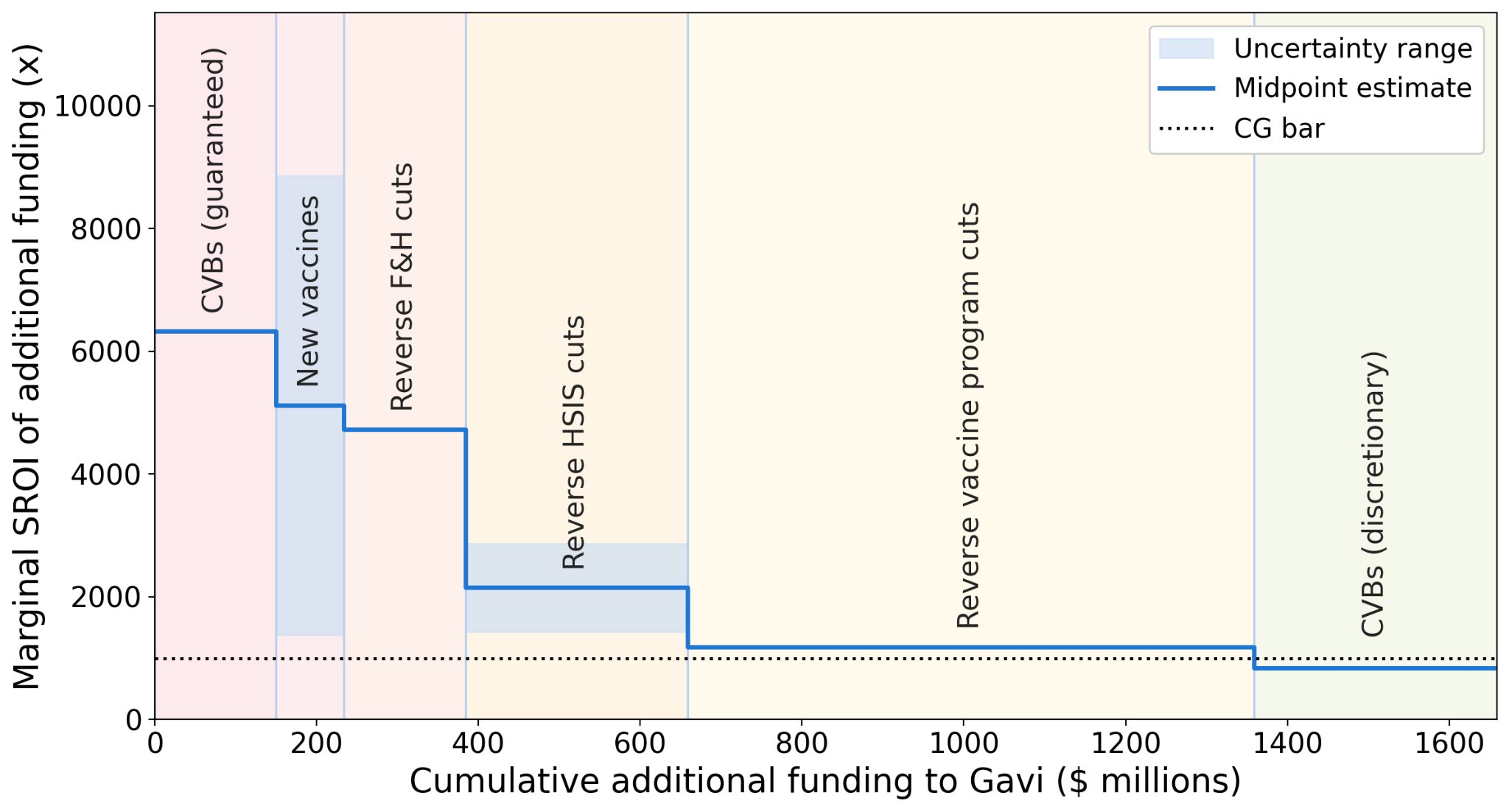
Note. SROI = Social Return on Investment; CVBs = Country Vaccine Budgets; F&H = Fragile & Humanitarian Approach. HSIS = Health System & Immunization Strengthening. Cumulative additional funding to Gavi is based on a $1.7B shortfall (as of July 2026) and does not include the $600M contribution from the US. Solid blue lines indicate cost-weighted midpoint estimates of marginal SROI across each category of investment; light blue shading represents uncertainty ranges, where available. Only “new vaccines” and “reverse HSIS cuts” include uncertainty ranges because Gavi estimates included ranges for either or both costs and health impacts; all other estimates were based on point estimates only. Color shading is illustrative of cost-effectiveness (red = higher cost-effectiveness, green = lower cost-effectiveness). The dotted line represents CG’s cost-effectiveness bar (1,000X).
Our best guess estimates include the following considerations:
- Critical, highly cost-effective program gaps will be filled by the additional US funding. We expect that the gap in the guaranteed CVBs will not go unfilled, that some additional support will become available for F&H approaches, and that at least some of the recalibrated vaccine program cuts will be restored. This is based primarily on cost-effectiveness and areas that were indicated as high priorities for Gavi in our expert interviews. However, if some of the $600M does not go towards the most cost-effective programs, this could mean there are still highly cost-effective 5,000–6,000X funding gaps left on the table.
- Expanding discretionary budgets for countries is a priority for Gavi. This is for two main reasons: it advances the goal of shifting decision-making authority to countries, and there is clear unmet demand from countries for additional programs for which they are already eligible. It would also likely be easier for Gavi to implement logistically than reversing specific elements of the recalibration.
- Vaccines newly entering the pipeline are likely not affected by recent funds. As these programs have not been explicitly earmarked for cuts–and the size of the budget allocated to them is relatively small at ~$65M–$100M–we think that this category is not a likely candidate for recent funds as there is no specific gap to fill. However, several programs (e.g., Mpox and RSV) are explicitly contingent on funding and are thus arguably at the margin. Additional philanthropic donations could potentially speed-up these programs.[32]
- Some marginal programs may have higher SROI than the average because Gavi does not make decisions solely based on cost-effectiveness. We expect that Gavi will not necessarily allocate funding in accordance with our cost-effectiveness estimates in Figure 3. For example, donors could earmark funds for certain programs, which would influence the margin, and “value for money” accounts for only 20% of the criteria used for their vaccine investment strategy (Gavi, 2024).[33]
This puts $59M of remaining opportunities in reversing HSIS cuts (~2,100X), if some of the $600M is assumed to go towards new vaccine programs (though we think this is unlikely).[34] If funds are not directed towards new vaccines, because they have not been explicitly cut by Gavi, then the next marginal opportunity would be ~$675M at ~1,200X to reverse vaccine program cuts. We also created an interactive tool (Rethink Priorities, 2026) to explore how different funding assumptions might translate into a different marginal SROI. Detailed explanations of our SROI estimates for each category can be found in the sections below.
Category 1: Reversal of Cost-Cutting Measures
We considered some of these cuts to be among the most likely to be reversed in the event of more funding. They include three broad buckets of cost-cutting measures that Gavi approved as part of the recalibrated budget:
- Reversing vaccine program cuts (~$700M): Changes in procurement for the following programs: M/MR, malaria, cholera, typhoid, multivalent meningitis, meningitis A, and Japanese encephalitis.
- Reversing HSIS cuts (~$275M): A reduction in the funding envelope for cash grants to countries by roughly 25%, which was intended for health system strengthening, support for new vaccine introductions and campaigns, and progress on the zero-dose agenda.[35]
- Reversing F&H cuts (~$150M): Cuts to support for countries experiencing fragility and conflict, as well as those in the catalytic phase (i.e., those transitioning away from Gavi support). These cuts involve reduced support for traditional vaccines, catch-up immunization, humanitarian programming, and catalytic-phase middle-income countries.
Our estimates of the cost-weighted SROI for each of these buckets of cut reversals is in Table 2 below, with more detailed estimates available in this spreadsheet.
Table 2: SROI midpoint estimates for reversing select budgetary cuts made during Gavi 6.0 recalibration
| Recalibration Budget Cut | Cost-Weighted SROI |
|---|---|
| Reversing vaccine program cuts (procurement) | 1,180 X |
| Reversing HSIS cuts | 2,149 X |
| Reversing cuts to the F&H Approach | 4,728 X |
Of these, we have moderate confidence that some vaccine programs would be a high priority for additional funds; for example, M/MR cuts were already scoped down in a refinement of the recalibration approach due to discomfort among Board members about the substantial health impact for relatively low cost savings (Gavi, 2025, p. 5). We also think that the F&H cuts are likely to be one of the higher-priority reversals, due to the high impact on loss of lives saved and Gavi’s general commitment to provide adequate support for the poorest countries first. Reversing HSIS cuts explicitly seems less likely to us because some of this support is implicitly absorbed by what is given to countries via the new CVBs.
Key Uncertainties Around the Malaria Program
Reversing the coverage cuts to the malaria program has been highlighted as a clear potential opportunity for philanthropic investment. By our calculations, the SROI of doing so is 434X, but we have substantial uncertainties about the assumptions underlying Gavi’s original projections, which could mean that this is an underestimate. It was unclear from Gavi’s internal modeling if the projections of cost savings and loss of lives saved include the negotiated reductions in per-dose cost of both RTS,S and R21 (the latter of which was announced only a week before the December 2025 board meeting). We think it is likely that the cost-effectiveness of the malaria program may be higher than we estimate here, due to its high impact[36] and recent price negotiations that will reduce future procurement costs by ~25–50%. For the cut in malaria coverage from 85% to 70% of moderate-high transmission areas, an anonymous expert also emphasized that it can be “tough to say with certainty whether there’s a clear segregation between moderate and high transmission,” meaning that the reduction in coverage could well include individuals in high-transmission areas lacking access to the vaccine. In addition, some countries have already exceeded the 70% threshold, meaning that if the cuts are not restored, those countries will potentially need to start scaling back programs from 2027, which runs contrary to Gavi’s strong preference for maintaining continuity of programs.
The balance of the two malaria vaccines also seems likely to shift in the future. Katharine Collins at CG also stated in an interview that, “recent unpublished data presented at conferences from the Phase 3 trial shows that R21 may be more durable than RTS,S.” Historically, a greater proportion of the malaria vaccines distributed by Gavi were RTS,S (due to earlier WHO approval), but because R21 now has both a greater production capacity and a lower cost (Nature, 2026), we expect that this balance will shift heavily towards R21 for future rollout.
Category 2: Increasing Country Vaccine Budgets
This category covers changes to the existing CVBs allocated for Gavi 6.0, including the expected $150M and $300M gaps in guaranteed and discretionary budgets, respectively. We estimated the individual SROI for each of the vaccine programs that are included in both guaranteed and discretionary budgets and take the cost-weighted SROI for both to report an average cost-effectiveness across each type of budget, shown in Table 3 below:
Table 3: SROI midpoint estimates for funds allocated to different types of CVBs, as of July 2026[37]
| CVB Type | Total Budget ($B) | Cost-Weighted SROI |
|---|---|---|
| Guaranteed budgets | $4.4 | 6,329 X |
| Discretionary budgets | $1.1 | 844 X |
Note: CVBs have increased from $5.3B at the recalibration to $5.5B total as of the July 2026 board meeting. Given the constant fluctuation in budgets allocated, we acknowledge that there may be minor inconsistencies in the size of the budget for CVBs.
We think it is very likely (>90% confidence) that the gap in guaranteed program budgets will not persist throughout Gavi 6.0, given the high cost-effectiveness of those programs and the likelihood of additional incoming funds to make up the gap in the later years. We also analyzed Gavi’s overall top-down forecast of the loss of lives saved due to unfunded CVBs (here) and estimated the midpoint SROI as 719X. This likely means that Gavi itself views the margin as coming from vaccines that make up the discretionary budgets, rather than guaranteed programs; to us, this appears to mean that Gavi also views it as unlikely that the highly cost-effective gap in guaranteed programs will go unfilled.
Within the discretionary programs, which vaccine falls at the margin will almost certainly vary substantially depending on country context, both in terms of differences in disease burdens as well as the strength of decision-making support within countries. This means that we expect that discretionary programs will have an SROI of 844X on average, but that the marginal vaccine within each country could have a higher or lower return than indicated by this categorical average.
Category 3: Vaccines Entering the Pipeline
This category covers vaccines planned to enter Gavi’s pipeline during Gavi 6.0, including four vaccines approved in VIS 2024 (dengue, tuberculosis [TB] for adolescents/adults, Hepatitis E, and Mpox),[38] alongside maternal RSV, which only moved from “in principle” to “active” after clearing WHO pre-qualification in March 2025 (WHO, 2025). Of these, four of the five have an existing licensed product, while the adult TB vaccine does not.[39] Ray Kennedy at CG mentioned in an interview that he thought it was plausible that if a new high-demand vaccine like TB is approved by regulators and Gavi, that could make it more likely that Gavi could raise additional philanthropic or aid funding because it would represent an exciting new opportunity for impact.[40]
One major difference between vaccines approved in VIS 2024 and those that are already part of the existing portfolio is that they target vaccinations beyond early childhood. Gavi has explicitly stated that it chose to strategically “widen its scope from its early focus on protecting infants th[r]ough routine immunization to also supporting vaccines for older children, adolescents and adults–including during outbreaks, epidemics and pandemics” (Gavi, 2024). This means that cost-effectiveness for some new vaccines will potentially be lower from CG’s standpoint, as fewer DALYs are accrued from the death of an adolescent or an adult compared to a child under 5.
Table 4 below shows our lower estimates of SROI for the five vaccines (assuming fully-funded programs) in Category 3. We use our lower bound here, rather than the midpoint, because we expect the cost-effectiveness estimates for new programs to be generally less reliable than for established programs with data on past costs and numbers vaccinated.
Table 4: SROI lower-bound estimates for vaccines newly entering the Gavi pipeline
| Vaccine | Target Population | SROI (Lower) |
|---|---|---|
| Dengue | 2–16-year-olds (conditional on African disease burden data) | 33 X |
| TB | Adolescents and adults | 3,754 X |
| Hepatitis E (stockpile) | High-risk populations in outbreak response | 330 X |
| Mpox (500,000 dose stockpile) | High-risk populations in outbreak response | 32 X |
| RSV | Pregnant women | 3,193 X |
Given the wide range in cost-effectiveness estimates, we expect that some of these vaccines would be a lower priority (e.g., dengue, in particular, appears to have very poor cost-effectiveness and future investments are explicitly dependent on the scale of the burden in Africa). Conversely, RSV and a TB vaccine for adolescents and adults are expected to be highly cost-effective, though the TB results depend heavily on a true efficacy estimate similar to that modeled by Gavi.
Key Conclusions
- We think the most cost-effective gaps will likely be absorbed by recent funding changes. We expect that most of the highly cost-effective funding gaps identified in this report—the guaranteed CVB shortfall, F&H cuts, and other high-SROI reversals of vaccine program cuts—will be absorbed by the $600M in US funding already unfrozen, and potentially by the entire remaining ~$1.1B shortfall if further anticipated US appropriations materialize over the rest of Gavi 6.0.
- However, Gavi’s allocation of the $600M will not necessarily be applied based on cost-effectiveness alone, potentially leaving open opportunities. As donors can earmark funds, and value-for-money is only one of several criteria in Gavi’s investment decisions, funds will probably not be allocated strictly according to cost-effectiveness. If a meaningful share of recent funding does not flow to the most cost-effective programs, some highly attractive 5,000–6,000X opportunities (e.g., guaranteed CVBs, restoration of F&H cuts) could remain unfilled even after the gap is nominally closed.
- This creates a distinct role for philanthropy, which could reduce the risk of highly cost-effective opportunities being left on the table. Rather than giving unrestricted funds that Gavi might allocate less efficiently, donors could direct money toward specific, high-SROI gaps (e.g., guaranteed CVBs, F&H restoration) to ensure these particular opportunities get closed, regardless of how the broader US funding picture resolves.
- Our best guess is that the actual margin is currently around 850–2,100X. If previous funds are allocated largely according to cost-effectiveness, this would push philanthropic funding towards areas like reducing vaccine program cuts (~1,200X on average) or expanding discretionary budgets for countries (~850X on average).
- Marginal SROI beyond the original Gavi 6.0 ambitions is unknown, but likely <850X. We did not assess the continued cascade of marginal SROI beyond the unfunded opportunities associated with the funding shortfall, but expect that it would fall below our lower-bound estimate of ~850X.
Contributions and Acknowledgments
Britta Jewell researched and wrote the report and served as project lead. Jerome Mayaud supervised the project.
Special thanks to Abbie Clare for helpful comments on drafts, and to Rebca van de Ven at Coefficient Giving, for their input. Thanks also to Thais Jacomassi for copyediting, and to Ula Zarosa and Maja Nenadov Webster for assistance with publishing the report online. Further thanks to Pete Baker, Katharine Collins, Ray Kennedy, and one anonymous expert for taking the time to speak with us.
Coefficient Giving provided funding for this report, but it does not necessarily endorse our conclusions.
Appendix
What We Would Do With More Time
- Because the announcement that the US released substantial funds for Gavi came towards the end of the project, the structure of our report reflects an already somewhat-outdated view of Gavi’s marginal cost-effectiveness. If we had more time, we would have spent more of our research digging into what the margin looks like beyond the targeted ambitions for Gavi 6.0.
- We would have liked to interview more than one person at Gavi to have a better understanding of the complex internal decision-making processes that Gavi goes through, as well as where philanthropic funds would be most likely allocated. We tried to schedule an interview with Björn Gillsäter, Managing Director of Global Donor Relations, Advocacy and Fundraising, but were unable to find an interview time before the end of the project.
- We would have liked to speak to someone at the Gates Foundation who works on Gavi programming to gain a better understanding of how a large-scale philanthropic donor approaches marginal cost-effectiveness questions. We emailed three people on the Immunization Team at the Gates Foundation but did not receive a response from any of them.
- We would do a deeper dive into specific vaccine budgets by country to get a better handle on which vaccines are marginal across countries. We think it’s possible to answer this question on a country level, but it would involve substantially more research and consultations with different experts.
- We would have read Gavi’s most recent July 1–2, 2026 board meeting documents (Gavi, 2026) in more detail to make sure that we understood the current state of affairs thoroughly, but did not have enough time to do so.
Appendix A: Country Vaccine Budgets for Gavi 6.0
Figure A1: Division of CVBs for guaranteed and discretionary budgets for Gavi 6.0
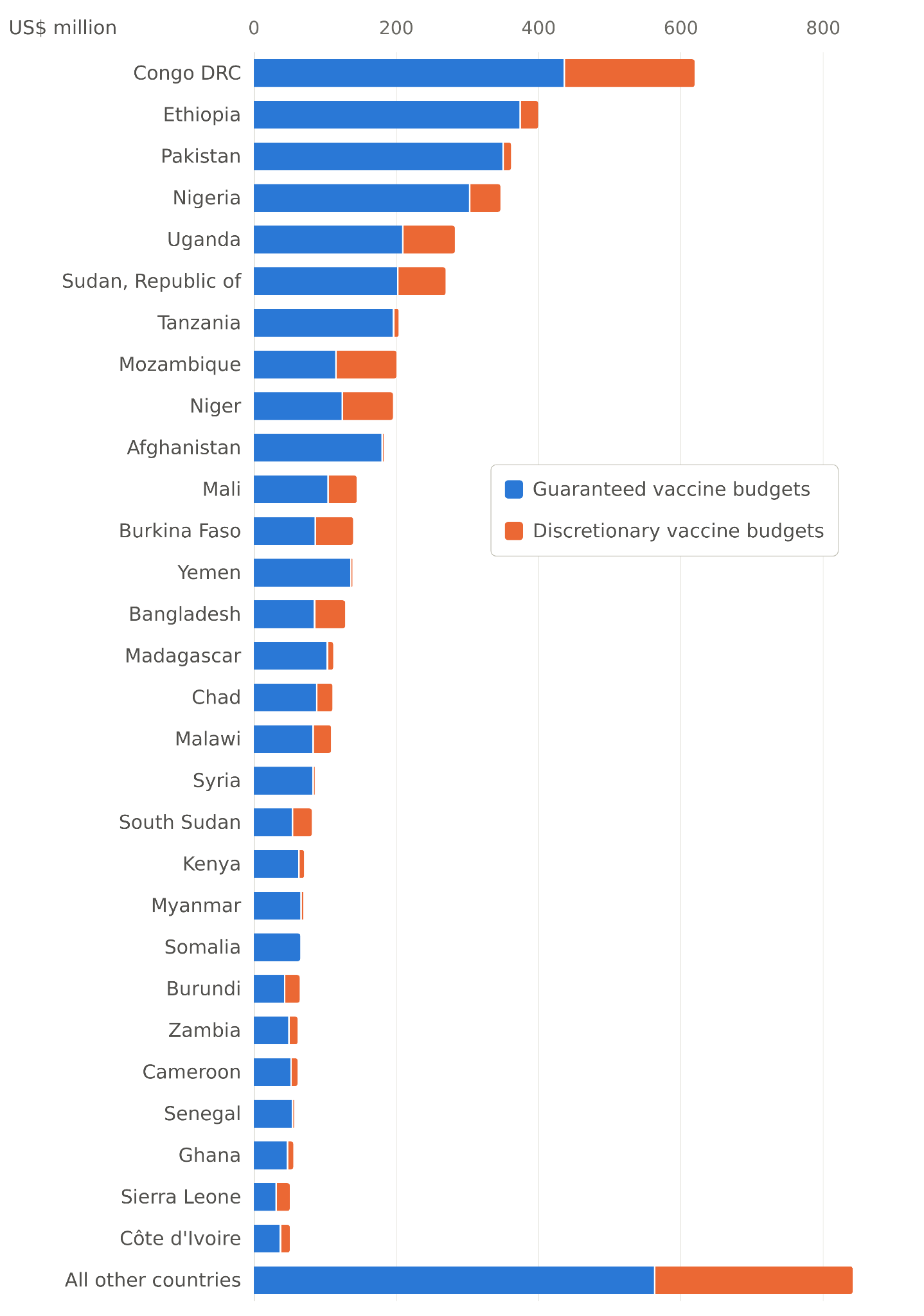
Note. Gavi (2026, p. 7). Figures are valid as of June 18, 2026.
Appendix B: Proposed Timelines for Vaccines Approved in VIS 2024
Figure B1: Proposed timelines for vaccines approved
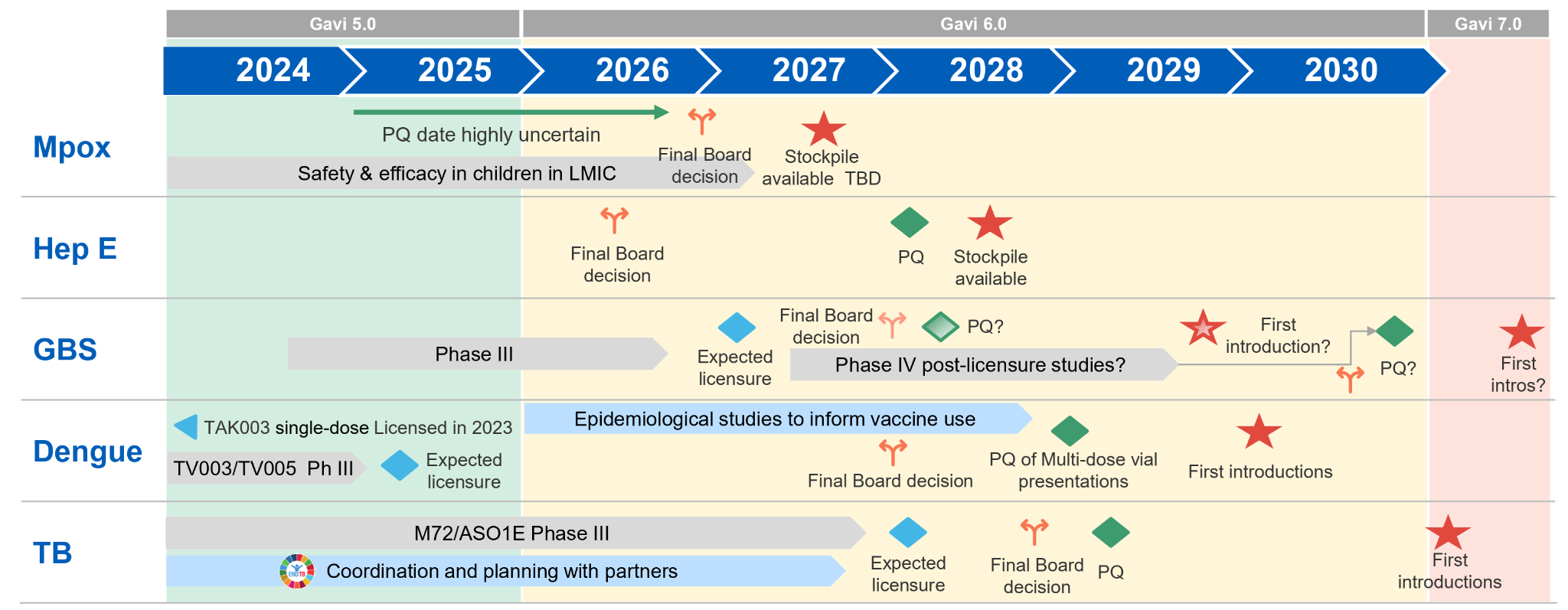
Note. Gavi (2024, p. 3).
Appendix C: Gavi’s Country Co-Financing Model in 2026
Figure C1: Gavi’s country co-financing model through different phases
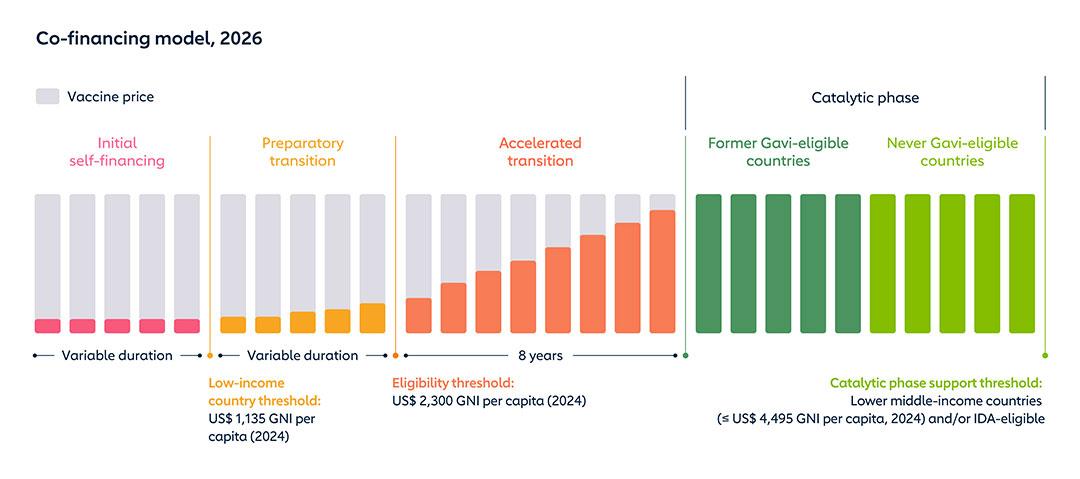
Note. Gavi (2026).
- I.e., each dollar CG gives should generate a benefit equivalent to giving $1,000 to someone earning about $50,000/year, or saving a year of healthy life for $100. ↑
- Support to countries experiencing chronic fragility (e.g., conflict or political instability) and those facing acute emergencies (e.g., natural disasters or mass displacement). ↑
- Cash grants that help countries build stronger health system capacity, including infrastructure development, health worker training, and program management. ↑
- To reach an additional 500 million children, avert 8–9 million deaths, support a 10% reduction in under-5 mortality, and generate roughly $100B in economic benefits (Gavi, 2026). ↑
- The US had pledged $1.17B for Gavi 5.0 in 2020, and the Biden administration had committed $1.58B to Gavi 6.0 (USAID, 2024) before the Trump administration originally reversed the pledge (Tanis, 2025). ↑
- Note that most of this report was written before the additional US funding was announced, so we assess the larger ~$1.7B gap before zeroing in on cost-effectiveness at the current margin. ↑
- The organization also aims to cut ~$400M from health systems support and $260M from Secretariat costs, as well as achieving ~$500M in market shaping and ~$100M in co-financing savings. ↑
- Additional program changes resulting in lives lost include typhoid, multivalent meningitis, meningitis A, and Japanese encephalitis, though we did not see a specific estimate of cost savings attached to these cuts. ↑
- Specifically, Cambodia, Lao, Kyrgyzstan, Democratic People’s Republic of Korea, Solomon Islands, and Tajikistan. ↑
- Gavi’s Secretariat can also lower the cap if a country lacks the capacity to use all of the funds allocated, redistributing the money elsewhere. ↑
- Ray Kennedy (CG): “If you come with a malaria vaccine [and] that is the number one problem that every single person in my country … has heard about, they will prioritize that over other vaccines, definitely. My guess would be that it won’t be perfectly linked to cost-effectiveness, it’ll be more linked to the size of disease burden and number of people who can benefit.” ↑
- This might mean that it would be easier for Gavi to increase CVBs than to partially restore the malaria program cuts, for example. ↑
- Anonymous Gavi expert: “If you had to pick a few [from a] list, then naturally vaccine procurement would always get priority.” ↑
- Kennedy: “My understanding is that once they’ve said a vaccine is in, they don’t like to take it out. So even if the next one in the queue is actually more cost-effective than the previous one, they won’t replace [it] and say, ‘oh, we’re not supporting [that] anymore, we’re supporting [this other vaccine]…It does mean, in a funny sort of way, their marginal cost-effectiveness could be actually better than it might look, if the next thing in the queue is really cost-effective and they’re actually not going to do that without funding.” ↑
- Support to countries experiencing chronic fragility (e.g., conflict or political instability) and those facing acute emergencies (e.g., natural disasters or mass displacement). ↑
- Note that we do not assess the cost-effectiveness of outbreak response in general in our models below, due to complexity and the lack of associated health impact forecasts from Gavi. ↑
- We assessed their cost-effectiveness nonetheless, as some programs are explicitly listed as contingent on funding. ↑
- We also included cases in which costs were inferable based on health impact, though these should be treated with substantial caution since they are derived from our own estimates. ↑
- Some changes to vaccine procurement involve a schedule change; for example, hexavalent was switched from a four-dose to a three-dose schedule in the recalibration, with no assumed loss of lives. We did not consider these changes as priorities for reversal because there was no expected health impact. ↑
- Cash grants that help countries build stronger health system capacity, including infrastructure development, health worker training, and program management. ↑
- In an interview, an anonymous expert at Gavi listed expansion of CVBs as one of the most likely changes to occur in the event of further fundraising: “There are a few broad avenues where this money–in whatever quantity we receive–goes. It will, for one [example], surely go towards topping up gaps in the discretionary budget [because] we know that the discretionary budget as it stands is not enough to cover the demand for the [those] programs.” ↑
- For example, approvals for Mpox and RSV were made “contingent on financial resources being made available for the Gavi 6.0 strategic period” (Gavi, 2025 and Gavi, 2025, respectively). ↑
- This covers the Gavi 6.0 strategic period only; we chose this time horizon to be consistent across all categories of investment and because Gavi’s financial resources and plans may be substantially different in later strategic periods. Health benefits are accrued over the lifetime of cohorts reached during the strategic period and are undiscounted. ↑
- In an expert interview, Pete Baker (CGD) indicated that he thought Gavi’s figures were generally reliable at the margin: “There’s one bit of extreme unreliability around the first [several billion] of Gavi’s money, because that will displace a chunk of government money that would have done it otherwise. And then at some point governments just stop buying vaccines because they know Gavi will do it….[but] we’ve definitely maxed out displacement now, [so that] makes their measurements more accurate. So as long as you forget about that, which you can at the margin, then they become more accurate.” ↑
- For diseases in which specific estimates were available from the Global Burden of Disease (GBD) study, we calculated the ratio of years of life lost (YLLs) to years lived with disability (YLDs) to assess how much we would expect overall DALYs to increase if we included morbidity (see our calculations here). For almost all diseases that Gavi vaccinates against, <5% of the total DALY burden came from YLDs (encephalitis is the only exception, where ~12% of DALYs are from YLDs). We therefore think that including morbidity would change most of our SROI estimates very minimally. ↑
- This is largely based on our previous assessment of the accuracy of Gavi’s internal estimates (van Schoubroeck et al., 2026), which was that forecasts of lives saved were generally justified, but that there were limitations to using academic modeling and that Gavi assumes vaccinations would not occur counterfactually if they did not provide them. ↑
- It seems plausible that lives lost could be underestimated if the adjustment to recalibrated Gavi support goes worse than planned; for example, countries could lack the support to allocate their discretionary vaccine budgets well, resulting in excess deaths. Conversely, domestic resources might be at least partially reallocated to backfill the gaps left by Gavi, limiting the health impact at least partially. Finally, Gavi has an implicit incentive to project a substantial number of lives lost as a result of lack of funding in order to mobilize future funding and create political pressure, but our sense is that Gavi would risk some of its reputation if these numbers were drastically off. ↑
- This is the average percentage of deaths under 5 across Gavi countries in a modeling analysis (Li et al., 2021, p. 403). ↑
- We did not have time to estimate this for every vaccine, so we used a standard ratio across all programs. An anonymous expert at Gavi told us that a reasonable ballpark figure was that Gavi would pay for 70–75% of total vaccine procurement costs. To account for operational and delivery costs, we revised this figure downwards to ~50%. This is inevitably a major oversimplification, but our SROI estimates are not very sensitive to country expenditure (e.g., a tripling of country costs reduces the average SROI by ~3% for reversing program cuts), so we do not believe further investigation would change our results meaningfully. ↑
- This figure was confirmed as a reasonable ballpark estimate of counterfactual government spending in an email with Peter Hickman at CG. ↑
- In other words, (0,0) in Figure 3 represents additional funding beyond the $10.2B forecasted resources at Gavi’s July 2026 board meeting, but does not include the recent $600M contributions from the US. ↑
- For example, while no adult TB vaccine candidate has been approved, if this were to happen during the tail end of Gavi 6.0, we expect there would be high demand from countries, given the size of the disease burden and its projected cost-effectiveness. This demand would likely not be met with current budgets. ↑
- The complete criteria are health impact (40%), value for money (20%), equity and social protection (20%), Gavi comparative advantage (10%), and economic impact (10%). ↑
- The $600M, if allocated according to cost-effectiveness and including funding for new vaccines, would go towards guaranteed budgets ($150M), new vaccines ($84M), reversing F&H cuts ($150M), and reversing HSIS cuts ($216M/$275M required, leaving $59M unfilled). ↑
- Gavi’s “zero-dose agenda” is the strategic push to find and reach all children who haven’t received a single dose of the DTP-containing vaccine (the standard proxy for “no immunization at all”). ↑
- An anonymous expert at Gavi underscored that the health impact is high relative to other vaccines in the portfolio: “It’s in the top half, maybe even in the top quarter of vaccines when it comes to its impact,” but on cost-effectiveness, it gets “trumped by other vaccines [because it’s so expensive].” ↑
- Gavi (2026, p. 4). ↑
- Group B Streptococcus (GBS) was also approved as an in-principle investment in VIS 2024, but there is no projected investment or deaths averted in Gavi 6.0, so we excluded it from our analysis here. ↑
- The leading candidate, M72/AS01E, is currently in Phase 3 trials (Gates Medical Research Institute, 2026). This means that efficacy is currently unknown, which could have major implications for Gavi’s projected health impact of the vaccine, and thereby its cost-effectiveness. ↑
- Kennedy: “I think in terms of a fundraising story, if there is a big, new, expensive vaccine that Gavi can show to donors, I could imagine that could help them actually raise more money. So saying, [we] need more money just to restore our existing things is a bit uncompelling, but [saying] for the first time, we can address this disease … I could imagine other donors saying, okay, we should really go for this.” ↑