


Rethink Priorities’ key
2026 achievements
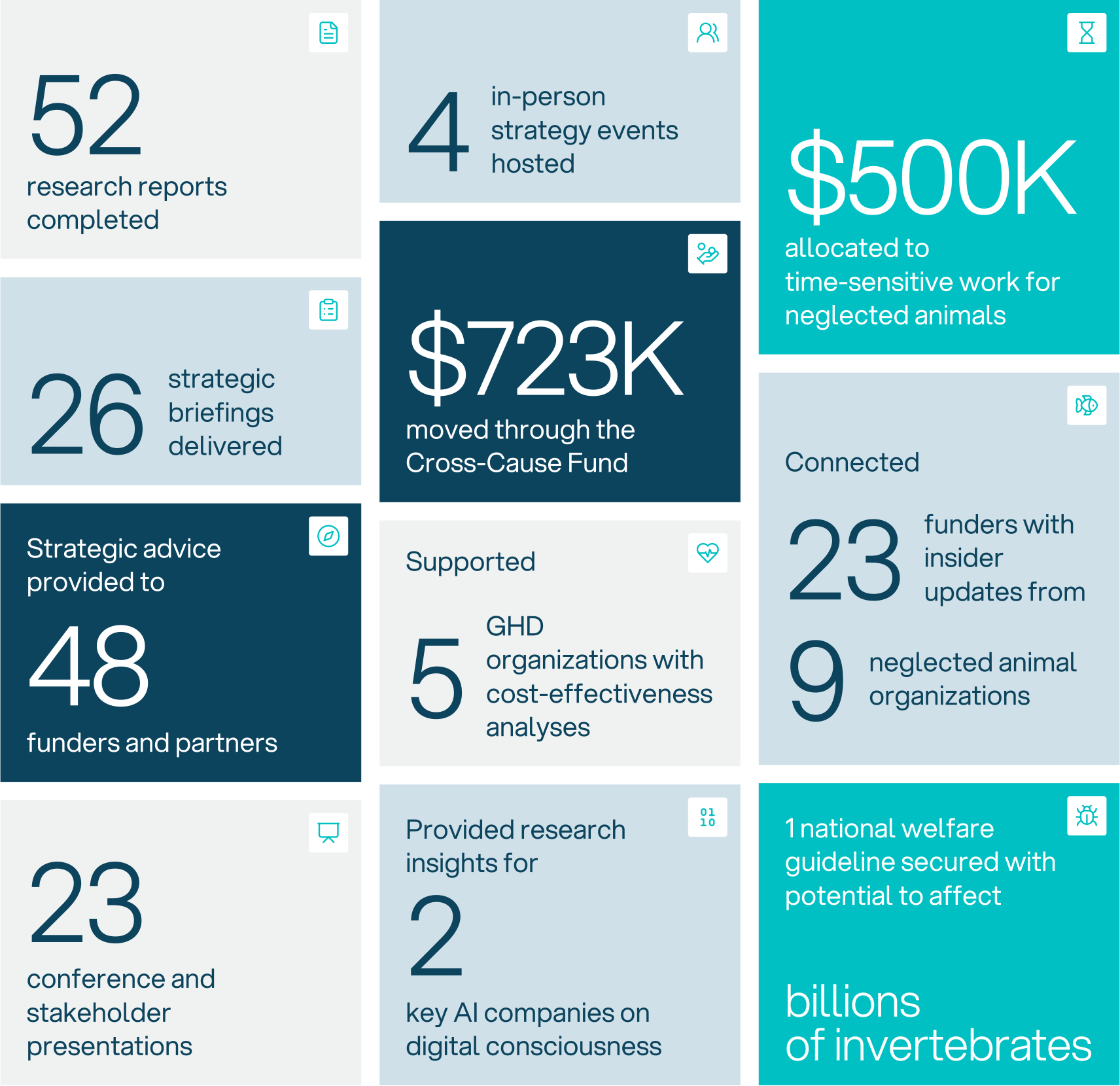
This year, we advanced research on digital consciousness, AI in global health, and wild animal welfare. We also took a strategic lead in neglected animal welfare, launched the Cross-Cause Fund, helped 14 promising projects grow, and more.
Any questions? Contact our development team.
Media Mentions









Global Health
and Development
We furthered the conversation on emerging opportunities and the growing role of AI in global health, and continued equipping global health decision-makers and practitioners with the evidence they need to maximize their impact.
22
17
1
5
Uncovered opportunities in global health sub-spaces
We identified impactful, neglected areas and explored questions we think deserve more attention, including the most consequential evidence-quality gaps underlying IHME’s disease burden estimates, the potential to reduce significant health burden by addressing fungal diseases (forthcoming), and the most promising avenues for health impact as AI adoption continues across global health subtopics.
Brought systems-level thinking to health and CHWs
We see health systems strengthening as a neglected problem that needs addressing from multiple angles. In 2026, this included a landscape scan of AI applications in health, exploring how we can improve the evidence base on the global burden of disease, and presenting Community Health Workers (CHWs) as an investment in their own right (publication forthcoming).
Offered a fresh perspective on climate interventions
We identified the circumstances in which climate interventions would be as or more cost-effective than health interventions, indicated that the harms from Earth system destabilization could justify a new philanthropic cause area within climate change, and explored where and how rapid, transformative AI might shift the climate mitigation landscape and, therefore, climate philanthropy (publication forthcoming).
Produced 5 CEAs for implementers aiming to scale
Our support in building or improving cost-effectiveness analyses (CEAs) helped implementers make a rigorous case for investment in their programs and plan careful, efficient scaling. For example, our work with Sanku revealed that switching to bioavailable iron in their flour premix would double their cost-effectiveness; Sanku has subsequently been selected as a grantee of the ICONIQ Impact Child Survival Portfolio.
Animal Welfare
In 2026, we tackled key barriers to progress for neglected animals: We deployed ~$500K to time-sensitive opportunities, helped new researchers and founders enter the field, and built tools and evidence that advocates and funders can act on.
Tens of billions
$500K
23
$50K
35
2
19
Allocated ~$500K to improve the welfare of neglected animals
Our Neglected Animals Project Fund lets us respond quickly when brief windows for impact arise. It has enabled us to help establish welfare guidelines in a Global South country; help advocates start and scale work in three neglected, high-production regions; and commission scoping reviews of new approaches, including identifying a time-sensitive intervention which an advocacy organization is now pursuing. Together, these activities have the potential to affect tens of billions of insects annually. Full details of the fund’s impact may be shared with selected stakeholders on request.
Mapped near-term interventions to reduce wild animal suffering
We published a database of existing near-term interventions to reduce wild animal suffering, evaluating opportunities including population control, environmental adaptations, disease control, underwater noise abatement, and wildlife crossings. We assessed each intervention for five criteria for impact potential.
Successfully piloted a Talent Program
From March to September 2026, we mentored three promising researchers through a paid fellowship program in our Animal Welfare Department. They worked on frontier animal welfare questions, including second-order risks of breeding farmed animals for higher welfare, room for more funding in the wild animal welfare movement, and key open questions on insect welfare. Dr. Rey Edison has since been hired by RP as a full-time Researcher, Shloka Janapaty now works as a Researcher at Fairer Fields, and Dr. Tristan Katz continues to work with RP as a contractor on wild animal welfare topics. With recently secured funding, we will expand the program in 2027.
Launched a Shrimp Corporate Commitment Tracker
The first version of our Shrimp Corporate Commitment Tracker is helping advocates and funders prioritize targets and understand campaign impact. It will cover seven countries by the end of 2026, and its figures were used by an organization interviewed by Der Spiegel.
Helped launch Better Hatch Network to end male chick culling in Asia Pacific
The Better Hatch Network (BHN) aims to accelerate the adoption of in-ovo sexing technology to eliminate male chick culling in Asia Pacific. Our financial support and strategic guidance encouraged the founders to both commit to their idea and launch it sooner than they otherwise would have. BHN has since secured fiscal sponsorship from SparkWell and funding from the Strategic Animal Funding Circle, the EA Animal Welfare Fund, and through Senterra Funders’ donor network. The counterfactual value we saw here led us to design a Founders Program, which we plan to pilot in 2027.
Expanded the evidence base for aquatic animal welfare
Building on the European fish welfare roadmap we helped develop in 2025, we continued to address knowledge bottlenecks. We published research on the efficacy of electrical stunning for finfish, investigated farmed salmon welfare issues, and published a three-part series on how AI is reshaping aquaculture. We presented the latter in a webinar and at the CARE Conference, and our report was featured in Civil Eats.
Cross-Cause
Prioritization
We helped donors compare giving opportunities across philanthropic causes: We launched the RP Cross-Cause Fund (CCF) built on a model that accounts for key moral and empirical uncertainties and recommends a donation split across high-impact funds. This is a joint effort of the Worldview Investigations Team, the dedicated CCF team, and other departments.
$723K
8
cause areas vetted
$428K
5
Launched the Rethink Priorities Cross-Cause Fund
The Rethink Priorities Cross-Cause Fund helps donors allocate their giving across cause areas, such as Global Health and Development, Animal Welfare, and Global Catastrophic Risks via research-vetted, high-impact giving funds. To date, $723K has been distributed through the CCF.
Introduced a customizable Donor Compass tool
We released the Donor Compass, an interactive tool that helps philanthropists model their giving across causes based on their preferences. It outputs a custom allocation informed by Rethink Priorities’ cross-cause prioritization research.
Modeled key uncertainties for cross-cause prioritization
Our research addressed moral weights, time discounting, risk attitudes, aggregation across ethical views, AI-related uncertainty, and empirical uncertainty within each giving opportunity. Key insights were published as methodology briefs and a series of blog posts.
Published in Bioethics
Our 2026 paper shows how our Moral Parliament Tool can support democratic decisions about allocating healthcare resources across three case studies. The approach offers a more generalizable alternative to existing methods for participatory algorithm design.
Developed standardized guidance for measuring the counterfactual impact of donations
Our guidance helps effective giving organizations measure the counterfactual impact of the retail donations they move. Coefficient Giving has adopted the recommendations and said it improved their decision-making in their recent RFP. Six more effective giving organizations plan to incorporate the recommendations, and over 145 people attended our webinar on them.
AI Cognition
Institute (AICI)
We developed the first systematic, probabilistic benchmark of AI consciousness. We investigated AI risk attitudes, questioned AI introspection, and estimated the number of future digital minds.
2
200+
13
1
in The Economist
Launched the first probabilistic benchmark of AI consciousness
With the Digital Consciousness Model (DCM), we assess the evidence for consciousness in AI systems in a systematic, probabilistic way across 13 leading theories and perspectives. The model provides a shared framework for comparing different AIs and biological organisms, and for tracking how the evidence changes over time as AI develops.
Published with leading researchers
AICI's Arvo Muñoz Morán co-authored a 150-page framework for assessing AI consciousness with leading consciousness and AI researchers, including Anil Seth, Shamil Chandaria, Murray Shanahan, and Shane Legg; the accompanying interactive tool is hosted on the AICI website.
Featured in The Economist
In its August 20, 2026 cover briefing, The Economist reported on our Digital Consciousness Model (DCM) and presented an interactive visualization of its results. AI Insider and the Lives Well Lived podcast also covered our research, and mentions appeared in places like Forbes and the 80,000 Hours podcast.
Debated the case against AI consciousness in academia
We co-organized an academic conference on biological naturalism at the University of California, Los Angeles with the UCLA Department of Philosophy. In the lead-up, we published a comprehensive landscape of biological naturalism as a research program.
Benchmarked AI risk attitudes
We measured the stability and consistency of risk attitude benchmarks across a variety of test environments and found that AI models are becoming less risk-averse and behaving more like expected utility maximizers.
Estimated the number of future digital minds
We published a research report forecasting how many digital minds could exist by 2050.
Special Projects
We significantly expanded the Special Projects team and positioned ourselves for the next wave of growth, which will allow us to accelerate and amplify the impact of even more projects.
14
5
62
$9M+
Received a major grant from Coefficient Giving to scale up our support
With a grant made in September 2026, Coefficient Giving is supporting the expansion of Special Projects at Rethink Priorities, so we can provide even more high-impact projects with fiscal sponsorship and other operations-focused services.
Onboarded 5 new AI Safety projects
We supported five new projects focusing on AI safety in 2026: Arrow Research, Stabl (formerly Trellis Lab), Sampura Research, Generality Labs, Allelo Project. They are now scaling rapidly, bringing our supported portfolio to 14 Special Projects assisted.
Supported IAPS Summer Fellowships and the Animal Advocacy Strategy Forum
In addition to core fiscal sponsorship support, Special Projects provided support for multiple key programs and events with over 100 participants total. This included operational support for the 2026 summer fellowship program of the Institute for AI Policy and Strategy (IAPS), and event planning support for the Animal Advocacy Strategy Forum.
Led 62 employee onboardings
Our team helped the supported projects onboard a total of 62 employees, including 4 successful visa sponsorship applications in the UK and US. We also onboarded more than 40 contractors to help our projects further their mission.
Major gifts
Discuss major gift opportunities
for outsized impact
Connect with our development team to explore strategic giving opportunities and learn about specific high-impact funding needs. We’re happy to arrange a call if you have any questions or wish to take a more in-depth look at our plans and priorities.
Whitney Childs
Contact for opportunities in our GHD department

Hannah Tookey
Contact for opportunities in our Animal Welfare department
Angela Aristizábal
Contact for the RP Cross-Cause Fund
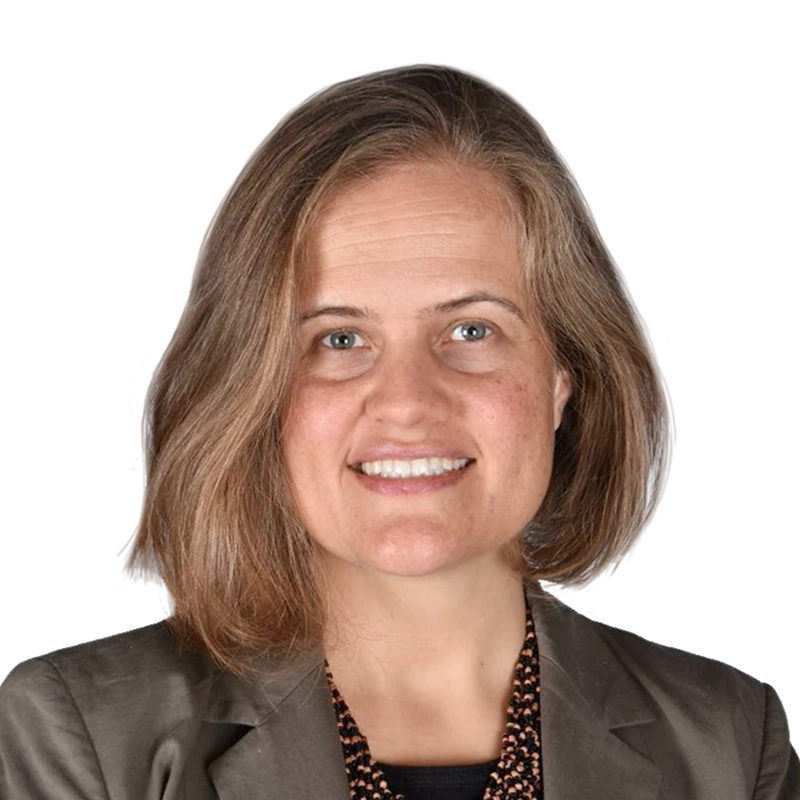
Janique Behman
Contact for AICI, WIT, AI Strategy, and unrestricted funding
General questions: reach out to our development team, and we’ll connect
you with the team member who can best address your interests.
Support our work
Fund research and strategy that guides grantmakers, policymakers, and nonprofits toward the most cost-effective, evidence-backed solutions
or go to our Donate page to learn more